
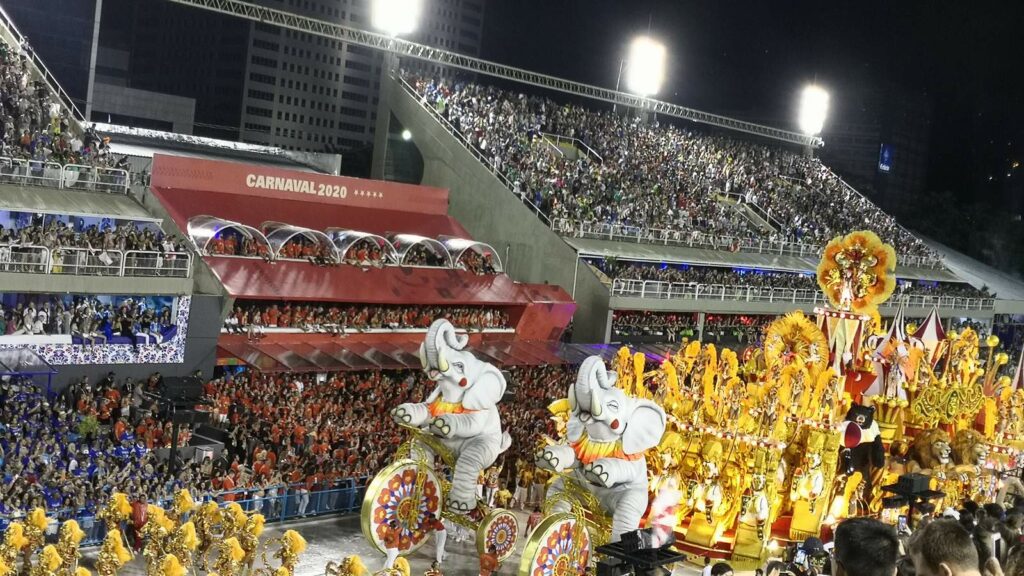
Rio de Janeiro Carnival is the five-day festival that turns an entire city into a stage. In 2026, it drew around 6 million people onto the streets, and the next edition, running February 5–13, 2027, is shaping up just as big. If you've only ever seen it on TV, the real thing is bigger, louder, and far more organized than it looks. There's a whole structure behind the chaos, and it traces back further than most visitors realize.

We wrote this from Copacabana, where we've been running samba classes and Carnival experiences since 2009. Everything below is what we tell first-time visitors before their first Carnival in Rio.
What Is the Rio de Janeiro Carnival?
Rio de Janeiro Carnival is a five-day festival, held every February or March, built around samba school parades and free street parties called blocos. Its roots go back to Rio's old port district, an area once called "Pequena África" (Little Africa), where Afro-Brazilian dock workers kept their music and traditions alive after the 1860s. The first samba school, Deixa Falar, formed there in 1926, and the parade tradition it started has run every year since.
What most visitors don't realize: Carnival isn't one event. It's two, running side by side. There's the ticketed, televised Sambadrome parade, where the top 12 samba schools compete for the championship title. And there's the free, chaotic, much bigger version: the street blocos, where anyone can show up and dance.
Both matter. The Sambadrome is where you see Carnival as spectacle. The blocos are where you feel it as a local would.
When Is Rio de Janeiro Carnival 2027?
Rio Carnival 2027 runs from Friday, February 5 through Saturday, February 13, with the Sambadrome parades at their peak February 7-9 (RioCarnaval.org). That's the official window, but the party doesn't wait for it. Pre-Carnival blocos typically start rolling through the streets in mid-January, weeks before the main event, alongside open samba school rehearsals that visitors can attend.


The scale is hard to overstate. In 2026, Rio's economy saw R$5.9 billion in activity from Carnival, according to the City Hall of Rio de Janeiro (Prefeitura do Rio), with more than 1 million foreign tourists in the city on top of the millions of Brazilians who travel in from other states. Expect 2027 to run just as big.
If you're planning your trip, book your flights and hotel early. Rio hotel rates climb sharply during Carnival week, and most experienced travelers book 6-8 months out to avoid arriving to a sold-out city.
How the Sambadrome Parade Works
The Sambadrome, officially the Sambódromo Marquês de Sapucaí, was designed by Brazilian architect Oscar Niemeyer and built in just 120 days for the 1984 parade, on the same site where samba schools had already been holding their annual competition. The parade runway runs 700 meters long, with 560 meters of actual parade grounds, and the stands hold more than 80,000 spectators.
Rio has more than 70 registered samba schools, but only 12 make it into the Grupo Especial, the top division that parades at the Sambadrome. Each school gets 75 minutes or less to complete its parade, driven by a bateria (percussion section) of 250 to 300 drummers who set the pace while the entire school sings that year's samba at full volume.
Portela, Mangueira, and Beija-Flor currently hold the most championship titles, and Salgueiro is known specifically for its drum section, nicknamed "Furiosa."
A second division, the Grupo de Acesso, parades on the Friday and Saturday before the main event. The weekend after Carnival ends, the winning schools parade one more time at the Desfile das Campeãs, the Parade of Champions, a calmer and considerably easier ticket than the main nights.
Watching from the stands is one kind of Carnival experience. It's a show, and a genuinely spectacular one. But it's also a ticketed seat, watching professionals perform.
Street Blocos: Rio's Free, Everyday Carnival
If the Sambadrome is the show, the blocos are the party. Since a 2013 city law, street Carnival is guaranteed to stay free and open to everyone, no tickets, no closed-off areas. For 2026, Rio authorized 462 street blocos, with the city's tourism authority expecting around 6 million people across those street parties alone (Mercopress).
A bloco is a moving street party: a truck with a sound system, a crowd following it through a neighborhood, songs everyone knows the words to. The oldest still running, Cordão da Bola Preta, has done this every year since 1918. Some blocos have their own personality entirely: Céu na Terra opens Carnival at 6am in Santa Teresa, Sargento Pimenta is Beatles-themed and one of the city's biggest, Banda de Ipanema has been official cultural patrimony since 2004, and Filhos de Gandhi has celebrated Afro-Brazilian culture since the 1950s. Blocos often run from 5 or 6am until sunset, in heat that can pass 40°C.
What to Wear to Rio de Janeiro Carnival
Costume culture at Carnival is real, but it's more relaxed than people expect outside the Sambadrome. You don't need an elaborate outfit for a bloco: glitter, a colorful top, and comfortable shoes cover most of them. Sambadrome parade costumes are a different story entirely, hand-made with feathers, sequins, and sometimes Swarovski crystals, and they can cost $500 to $1,200 or more.
A few practical notes locals rarely mention to first-timers: leave the good jewelry at the hotel, wear shoes you can actually dance in for hours, and bring a small crossbody bag instead of anything that has to be carried. Comfort wins over spectacle by about the third hour.


Is Rio de Janeiro Carnival Safe for Tourists?
Yes, with the same common sense you'd use at any major festival, plus a bit more. Rio deployed 14,454 police officers for the 2026 Carnival specifically, and Copacabana, Ipanema, and Leblon carry a heavy, visible police presence throughout the week (Vanguard Attaché). The city also runs a dedicated tourist police unit, DEAT (Delegacia Especial de Apoio ao Turismo), based in Leblon, specifically to support visitors who run into trouble.
The specific precautions locals actually follow: use a belt bag instead of a shoulder bag, and keep your most important items, like keys, cash, and cards, secured there. Remove contactless payment from your phone before heading out, and consider carrying an older or backup phone instead of your main one. Hydrate seriously and wear sunscreen, especially for an early bloco in Carnival heat. And if you're new to the city, use the buddy system rather than exploring alone.
This is also, honestly, the biggest reason first-timers hire a local guide for at least one night: not fear, just not wanting to spend Carnival night worrying about logistics instead of dancing.
How to Experience Rio de Janeiro Carnival Like a Local
The version of Rio de Janeiro Carnival most tourists get is the Sambadrome on TV. The version cariocas actually live is closer to the streets: a samba class before you go out, a bloco with people who know which ones are worth it, and a night that ends with you actually dancing instead of filming.
Carnival is also just the loudest expression of something that happens year-round. Rio's samba tradition traces back to Pedra do Sal, a former dockworkers' meeting point in the old port district, recognized as an Urban Quilombo in 2005. It still hosts a free, open-air roda de samba (samba circle) every Monday night, arguably one of the most authentic samba experiences in the city, Carnival season or not.
That's the gap a guided experience closes. You get the safety of going with someone who knows the city, the costume and the samba basics so you're not standing on the sidelines, and a route built around what's actually happening that week instead of a fixed tourist itinerary.
Rio de Janeiro Carnival FAQ
How many days is Rio de Janeiro Carnival?
The official 2027 Carnival runs from February 5 through February 13, closing with the Champions Parade (RioCarnaval.org). Unofficially, pre-Carnival blocos start weeks earlier, in mid-January.
Do I need a ticket for Rio Carnival?
Only for the Sambadrome parade, which is ticketed and seated. Street blocos, which draw the largest crowds, are free and open to anyone, guaranteed by city law since 2013.
What is a samba school?
A samba school (escola de samba) is a community association built around Carnival, with its own colors, anthem, and yearly parade theme. The first, Deixa Falar, was founded in 1926, and 12 of Rio's top schools now compete each year at the Sambadrome.
Is it safe to go to Rio Carnival alone?
It can be, with precautions. Most solo travelers we meet still prefer their first bloco or parade night with a local guide, mostly for the logistics rather than fear. For the 2026 Carnival, Rio deployed over 14,000 police officers specifically for the event, and similar numbers are expected each year.
What's the difference between a bloco and the Sambadrome parade?
A bloco is a free, informal street party anyone can join. The Sambadrome parade is a ticketed, judged competition between 12 professional samba schools, each with a 75-minute limit to complete their performance. Most visitors experience both during a single trip.
Rio de Janeiro Carnival: The Short Version
Rio de Janeiro Carnival is bigger and better organized than it looks from a distance: 70-plus samba schools competing to be one of the 12 in the Sambadrome, 462 street blocos running on their own schedules, and a whole city set up to keep millions of people moving through it safely. The best way to experience it isn't picking one or the other. It's a bloco for the chaos and the Sambadrome (or a guided night out) for the spectacle, with someone local to help you tell the two apart.
If you want to skip the guesswork on your first night, our carnival tour in Rio de Janeiro starts with a samba class and includes a costume, guide, and transport. Everything except the nerves, which wear off fast.