
Samba in Rio de Janeiro: A Local Guide for Travellers
The dance of Rio Carnival explained by local dancers: the types of samba, where samba was born, and where you can dance it on your trip.
By Helio Borges, founder of Rio Samba Dancer · Updated November 2026
Samba is the dance style of Rio Carnival. The fast solo style you see in the parade is called samba no pé ("samba on your feet"): small, quick steps with relaxed knees and moving hips. You don't need a partner, and most beginners learn the basic step in a 1-hour class.
Is samba a solo or partner dance?
Both. The most popular style, samba no pé, is danced solo, so you don't need a partner. You see it at Carnival, in samba clubs and at street parties.
Samba de gafieira is a partner dance, a bit like a Brazilian ballroom style, with turns and close moves. Most travellers start with samba no pé because you can join the crowd straight away.
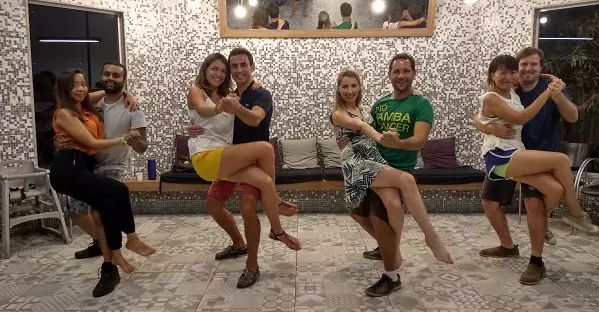
Samba de gafieira, the partner style from Rio's dance halls.
The main types of samba in Rio
Samba no pé
The fast solo dance of the Carnival parade. Small, quick steps, hips moving and a big smile.
Samba de gafieira
A partner dance born in Rio's dance halls, with turns, tricks and close moves.
Roda de samba
Not a step but an event. Musicians play around a table and everyone sings and dances around them.
Samba-enredo
The theme song each samba school creates and sings during its Carnival parade.
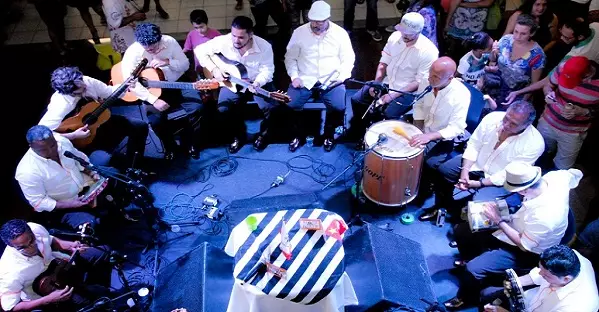
A roda de samba, the most authentic way to feel samba.
Where does samba come from?
Samba grew up in Rio in the early 1900s, around Pedra do Sal and the old port, an area known as "Little Africa". Afro-Brazilian communities met in houses like Tia Ciata's to play music and dance.
In 1916, Pelo Telefone became the first song registered as a samba. Today, the roots of Rio samba (partido-alto, samba de terreiro and samba-enredo) are recognised as Brazilian cultural heritage by IPHAN.
Dancing in Rio de Janeiro: where to find samba
Pedra do Sal
A street roda de samba in the old port area, where samba was born. Locals and visitors dance together in the open air.
Lapa
Rio's nightlife district, full of samba clubs with live bands. The best place for a real samba night out.
Samba school rehearsals
Big, loud practice nights before Carnival, with drums and the whole community dancing.
💡 Local tip: venues and dates change often. When you're in Rio, search "roda de samba hoje" (samba circle today).
How to start dancing samba on your trip
Learn the basic step
Take a 1-hour group samba class in Copacabana. Made for complete beginners: no partner, no experience.
Group Samba Class →Dance with a live band
Join the Samba Night Tour: class, transport and a local guide to a live samba club in Lapa.
Samba Night Tour →Dance in the street
On Mondays, take the class and then go with a guide to the Pedra do Sal street party.
Samba Street Party →Samba in Rio: questions
What dance style is performed at Rio Carnival?
Samba. In the Carnival parade, dancers perform samba no pé, a fast solo style with small, quick steps and moving hips. Each samba school also sings its own samba-enredo (theme song).
Do I need a partner to dance samba?
No. Samba no pé is a solo dance, so you can dance it alone at a club, a street party or Carnival.
Is samba hard to learn?
The basic step takes about 15 minutes to understand. After a 1-hour class, you'll know enough to join the dance floor.
Where can I dance samba in Rio de Janeiro?
At the Pedra do Sal street party on Monday nights, in the samba clubs of Lapa, and at samba school rehearsals before Carnival.
When is the best time to see samba in Rio?
All year, but the energy is highest from September to February, when samba schools rehearse for Carnival.
Ready to dance samba in Rio?
Join our 1-hour group samba class in Copacabana. Local instructors, small groups, no partner or experience needed.